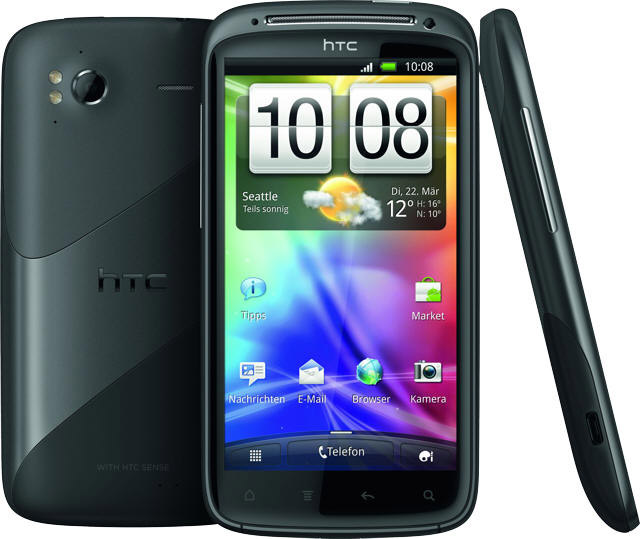
There was considerable lag with various widgets each time we locked the handset for awhile and then unlocked it. Sense UI was a bit of a mess, although we could attribute it to being an issue with this test unit, as you don’t expect sluggishness from a Gingerbread device running on a 1.2 GHz dual-core CPU with Adreno 220 GPU. Other than the issue with speed, HTC Sense UI is still the most competent interface to come preloaded onto a phone.
 The display itself is not as vibrant as
Xperia Arc or the Galaxy S II, but in terms
of image sharpness and color saturation,
we prefer it even if it’s a little harder to
see in bright sunlight. Another bit of a
let down was the video playback. None
of our DivX videos worked, so we were
forced to download a third party player.
Although the Sensation has no HDMI-out
support, it does support TV-out via MHL
as well as DLNA for streaming. Audio
playback wasn’t an issue though. Tones
were crisp and clear at a high enough
decibel level. With the added bonus of
EQ presets and SRS enhancements, we
thoroughly enjoyed the Sensation’s music
prowess.
The display itself is not as vibrant as
Xperia Arc or the Galaxy S II, but in terms
of image sharpness and color saturation,
we prefer it even if it’s a little harder to
see in bright sunlight. Another bit of a
let down was the video playback. None
of our DivX videos worked, so we were
forced to download a third party player.
Although the Sensation has no HDMI-out
support, it does support TV-out via MHL
as well as DLNA for streaming. Audio
playback wasn’t an issue though. Tones
were crisp and clear at a high enough
decibel level. With the added bonus of
EQ presets and SRS enhancements, we
thoroughly enjoyed the Sensation’s music
prowess.For connectivity, the Sensation’s got it all, from 3G with HSDPA 14.4 Mbps and HSUPA 5.76 Mbps, Wi-Fi with Hot Spot creation and DLNA, tethering support, Bluetooth 3.0 with A2DP and USB 2.0 with MHL. Thanks to Adobe Flash 10.3 support, Web browsing is enhanced, and setting up email is simple even for Microsoft Exchange. For the GPS module, aside from Google Maps, HTC’s Locations includes Footprints for Geotagging, adding notes to images, and 3D mapping with directions.
 The Sensation is equipped with an 8
megapixel auto and touch focus camera
with a dual LED flash. It features various
camera settings and fun effects, including
white balance, scene modes, ISO options,
geotagging and face detection. Video
records at 1080p and quality, although
slightly jittery, was not too bad. Image
quality is sharp, but just a little grainy in
native resolution, while colors seemed to
be retained quite well. On a full charge,
the Sensation ran for about a day and a
half, with standalone talk time of about
5 hours.
The Sensation is equipped with an 8
megapixel auto and touch focus camera
with a dual LED flash. It features various
camera settings and fun effects, including
white balance, scene modes, ISO options,
geotagging and face detection. Video
records at 1080p and quality, although
slightly jittery, was not too bad. Image
quality is sharp, but just a little grainy in
native resolution, while colors seemed to
be retained quite well. On a full charge,
the Sensation ran for about a day and a
half, with standalone talk time of about
5 hours.With a price tag of Rs. 32,000, which is Rs 2,000 more than the Galaxy S II, we’re not convinced that the Sensation is a worthy consideration. In fact, we’d rather go with the Incredible S that’s priced much lower.
VERDICT: A POWERFUL HIGH-END SMARTPHONE WITH A FEW DRAWBACKS.
FOR: Great display, good camera.
AGAINST: Buggy UI, poor video playback, expensive.

www.htc.com/in
Dimensions (WxHxD): 126.1 x 65.4 x 11.3 mm;
Weight: 148 g; Processor: 1.2 GHz dual-core processor,
Adreno 220 GPU; Memory: 1 GB internal; RAM: 768
MB; Display: 4.3-inch S-LCD, 540x940; Camera: 8 MP,
1080p video; Data: GPRS, EDGE, 3G, Bluetooth, Wi-Fi
N, microUSB.
No comments:
Post a Comment